ForeverL$U

ForeverL$U

The Golden Calf of Death Valley

This week the Southeastern Conference sued LSU in federal court and a Baton Rouge judge told the conference it could not punish the school for playing men who had already been paid to play. If you want to know how it got here, it did not start with Lane Kiffin. It started in 1931, with a stadium the Legislature would only pay for as a dormitory.

This is the whole record in one book: the building and every expansion; every head coach's pay from $13,000 to $91 million; every governor from Huey Long to Jeff Landry and what each one did to the stadium; the $25,000 lease, the "donation," the foundation, the lawsuit, and the one word nobody in Baton Rouge will say. A hundred and four pages. Ninety-six sources. Written by a five-degree LSU student who sued over the ticket in 2003 and kept the receipt.

I stood on the highest mountain. January 13, 2020. New Orleans. Fifteen and zero.
We are never getting it back.

Where we are, as of September 4, 2026

The SEC has sued LSU, its Board, its president, its athletic director and its coach in federal court in Alabama. A state judge has enjoined the conference and the NCAA from punishing any school that plays forty-two athletes the conference calls professionals. The governor fired the athletic director from a podium, then reversed a ticket price increase with a social media post, and no meeting. The coach was paid $54 million to leave and his replacement was paid $91 million to come. The foundation that leases the stadium for $25,000 a year still owns the seats on the upper decks. And the players who fill the building are the only students on campus the university refuses to call employees, because the day it does, the whole arrangement comes apart.

None of that is new. It is the same machine Huey built, running exactly as designed. This book shows you the machine, part by part, with the documents attached. Two dollars.

The calf

The calf was named in 2000, in a class on the American presidency, by a professor of cultural policy who looked out toward the stadium and told the room that Mark and Nick were out back building the golden calf. Mark was the chancellor. Nick was the coach. The book is dedicated to him. This is the check clearing.

Huey Long built Tiger Stadium by telling the Legislature it was a dormitory. He did it so the people who paid for the university could get inside it. A ticket was a dollar. The students bought the tiger for a quarter apiece.

Then the club came, and the statute, and the lease. The stadium was rented to a private foundation for $25,000 a year and rented back for millions. The right to buy a seat became a "donation," and a court said the donation was not a fee, over a dissent that quoted Humpty Dumpty. The chancellor who lit the arms race went on to run the NCAA and lose in the Supreme Court nine to nothing. His old chief of staff wrote the two largest buyouts in the history of the sport. A man suspended for not reporting a football player's confession is now the athletic director. And this week the Southeastern Conference sued LSU in federal court over its right to field men who were, six weeks ago, professional football players.

The calf is always made of the people's gold. Nobody stole it. We handed it over with both hands and asked for something shiny to follow. This site is the receipt: the book, the money, the governors, and every primary document the book relies on, free, because the public record belongs to you.

The ledger

A century of Saturday nights, entered the way a ledger enters them: what it cost, and who paid.

1924Tiger Stadium opens on the new campus, before most of the classrooms.about 12,000 seatsPaid by the state.
1932 to 1936Dormitories built in a straight line with the seats on top. Largest stadium in the South.44,000 seatsPaid by the state, a loan, and the WPA.
1934Train fare to the Vanderbilt game after Huey threatened the railroad's tax bill.$19 became $6Paid by Huey, on an IOU nobody collected.
1936A tiger from the Little Rock Zoo. Mike I.$750Paid by the students, a quarter each.
1950sA ticket. Maybe less.$1Paid by whoever did not get in through the hedges.
1936The north end: 24,000 seats on top of dormitories, the horseshoe. 46,000.$1,816,210.58The WPA carried more than half. About $42 million in today's money.
1953The south end closed, double-decked. 67,720 seats, largest on campus in the conference.state moneyThe last big addition built entirely on the public's account.
1955Paul Dietzel, three-year contract.$13,000 a yearPaid by the Board of Supervisors. He won the national title on it.
1978The west upper deck: about 10,000 seats, to 78,000.publicThe last addition the public built on its own.
1978The Varsity Club, the first donor account inside the department.privatePaid by donors. Renamed Tiger Athletic Foundation in 1987.
1992Act 1055. The foundation's books declared none of your business.no priceSigned by Edwin Edwards between an acquittal and a conviction.
1998A student ticket in the north end zone.$3Paid by the author, in cash, at the gate.
1999Gerry DiNardo's package: $150,000 base, $300,000 radio and TV, $135,000 endorsements.$585,000Fired in November. $600,000 to walk away.
1999Nick Saban, five years.$1.2 million a yearPaid by the department. The match.
2000The east upper deck: 11,600 seats and 70 Tiger Dens, borrowed and built by the foundation.privateThe first part of the building the public did not own. 91,600.
2002Mark Emmert's raise, seventy percent, plus a retention bonus.$490,000 + $100,000 a yearPaid by private foundations. The loan bought a house in Pensacola.
2003The stadium leased to the Tiger Athletic Foundation.$25,000 a yearLeased back to LSU for $2.5 million a year. The author sued. Lost.
2004The required "donation" to buy a season ticket.$85 to $400 a seatNot a fee, said the court. Deductible, said the IRS, until 2017.
2006A student ticket after Katrina and Rita.$12 or $18Paid by the students, for the hurricane, at the gate.
2008Tradition Fund, sideline seat between the twenties, by 2010.$500 became $950Approved three days after the title. One no vote.
2012The south end zone upper deck: 70 suites, 3,000 club seats, 1,500 general. Approved without objection.$80 millionOut of a $100 million foundation bond. 102,321 seats. Fifth largest in the country.
2010Mark Emmert becomes president of the NCAA.$2.7 million basePaid by amateurism.
2021Brian Kelly, ten years.$95 millionPaid by the department. Hired by Emmert's old chief of staff.
2021Suspension of the deputy athletic director for not reporting a domestic violence confession.30 daysPaid by him. He is the athletic director now.
2023Jimbo Fisher's buyout at Texas A&M, on a contract written by the same man.$75 million and changeThe largest in the history of the sport.
2025Brian Kelly's buyout.$54 millionThe second largest. Paid by LSU, after it tried to invent a reason not to.
2025A student season ticket, seven games, nonrefundable.$125Paid by the students. The three dollars did not come back.
2025A 2026 season-ticket increase, up to $125 a seat, approved on a Friday and withdrawn six weeks later after a Saturday blowout and a Sunday post from the governor.$0The machinery Huey built, running on the price of a ticket.
2025Lane Kiffin.$91 millionPaid by the department. A camera crew is included.
2026The SEC sues LSU in federal court in Alabama. The seat in front of you.a point totalPaid by you, annually, in February, as a donation.
Every line is sourced in the book and in the reading room.

The book

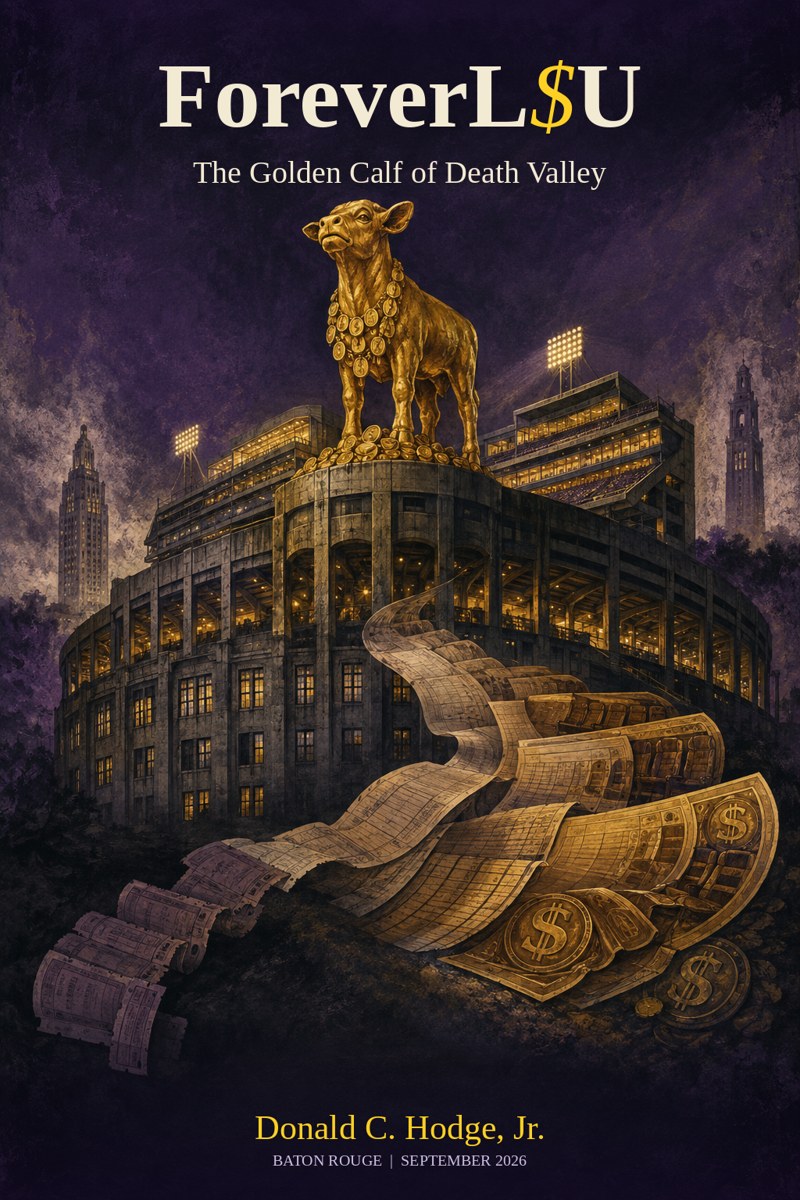
ForeverL$U: The Golden Calf of Death Valley. Cover: a golden calf on the roof of Tiger Stadium at night, with the state's money pouring down the stands.

Fifteen chapters, an interlude, a benediction, and two appendices, one of them the full 2003 opinion and the other a linked reading list, with the building's complete construction ledger, every head coach's pay from Dietzel to Kiffin, and the 2026 ticket prices as published, told first-person by a man who paid three dollars to stand in the north end zone in 1998 and who sued the Board of Supervisors in 2003, by himself, when the stadium was leased and the ticket became a donation. Satire built on a foundation of fact, which is also a fair description of Louisiana. Seventy-seven numbered sources.

It walks from Huey's dormitory to the Reveille Seven, from Dietzel's club to Edwards' statute, from Saban's match to Emmert's ascension, from the peak in the Superdome to the locked room and the descent, and it ends by grinding the calf to powder: seven proposals, beginning with the two that are going to happen whether Baton Rouge likes it or not.

The reading room

The book quotes freely from public documents because they belong to you. They are here in full: the 2003 First Circuit opinion in the author's own case, majority and dissent; the foundation statute, R.S. 17:3390, as Edwin Edwards signed it and three governors amended it; the fee provision of the state constitution; the 1958 ruling that struck down Louisiana's ban on integrated games; the 2021 reporting law; and the chapter of Exodus the whole book stands on. Every one of the seventy-seven sources in the notes is listed with a link to where it lives.

Open the reading room