You do not know you are descending until you have stood on the peak.
I stood on it once. January 13, 2020. The Superdome in New Orleans. Joe Burrow had the Heisman on the shelf and Clemson on the schedule. We won 42 to 25. Fifteen and zero. The band played. The building shook. Somebody near me cried and blamed the beer. It was me. It was not the beer.
I have stood on another peak since then. Mount Whitney, 14,505 feet, the highest ground in the lower forty-eight. You climb all day for the top. You get a photograph and a few minutes of thin air and a stranger's granola bar. Then you turn around, and every step for the rest of the day is down. Nobody tells you the descent is longer than the climb. Nobody tells you the descent is where the knees go, and that they go quietly, like a Board member's conscience.
That night in the Dome was the last LSU game I attended. I did not plan it that way. I just never went back. This is the story of why. It is also the story of what was already happening in the years I was walking into Tiger Stadium for three dollars, and of how the people who love this place most sat in the stands and watched it happen, because all we could do was watch.
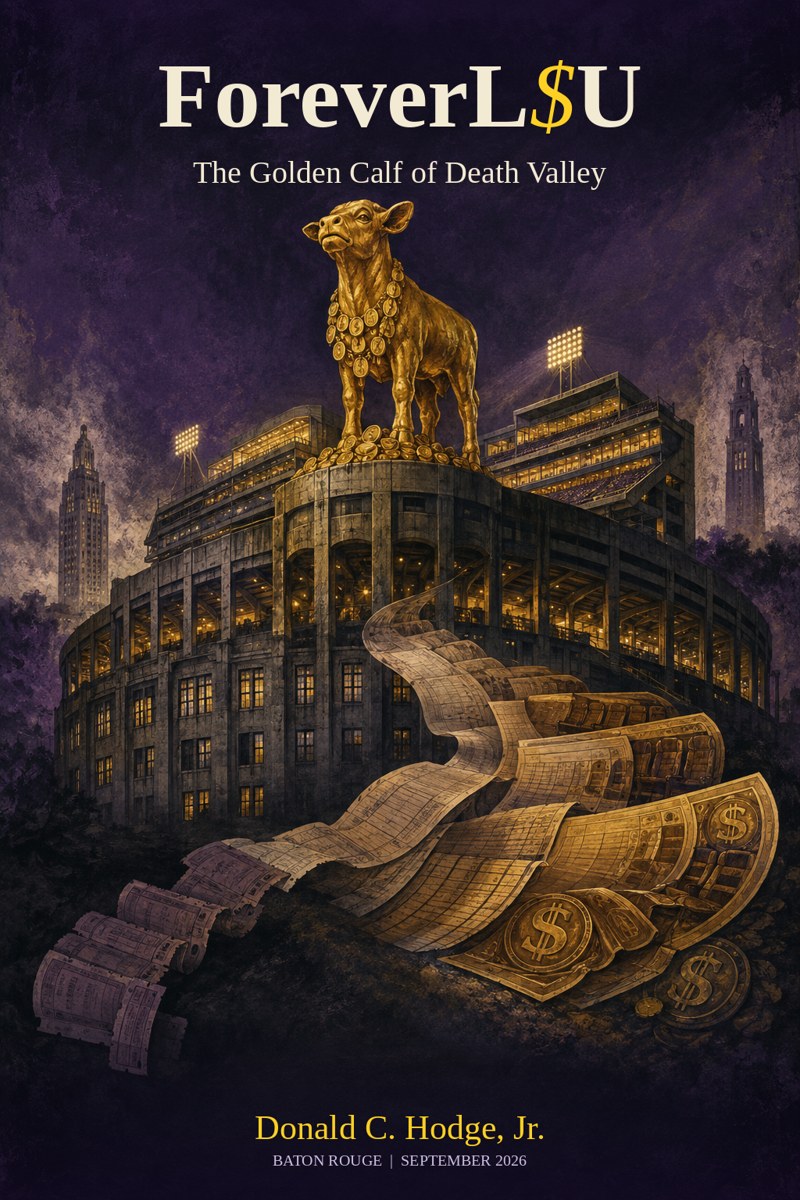
It is a story about a calf.
I did not name it. A professor did, out loud, in a classroom, in 2000, while the thing was still under construction. We will get to him.
I was raised Southern Baptist in Moss Bluff, which means two things. I can spot a collection plate in the dark, and I know that when the preacher starts talking about the building fund, somebody's earrings are about to go missing. So I have always read Exodus 32 differently than the Sunday school teachers taught it. When Moses went up the mountain, the people got nervous. They went to Aaron and asked for gods they could see. Aaron said, bring me your gold. They brought it, all of it, the earrings out of their own ears, and he melted it down and shaped it with a graving tool, and when it was finished they looked at it and said, these be thy gods, O Israel.
Read that again and notice whose gold it was. The calf is always made of the people's gold. Nobody stole it. The people handed it over with both hands and asked for something shiny to follow. And when the man came down off the mountain and saw what they had made, he ground it to powder and made them drink it.
We are not at the drinking part yet. We are at the dancing part. Tomorrow night the calf is on national television at 6:30 Central, with College GameDay set up in front of it and nearly nine hundred credentialed media inside the temple, the most in the history of the building. It will be a wild scene in Death Valley. Everyone says so. Everyone is paid to.
I will not be there. But I know every word of the liturgy, and I remember what it cost to get in.
Keep reading. Two dollars.